
A group, a year, a subgroup — which one did you mean?
The vocabulary that stops new FET users in their tracks, explained with an actual school instead of a definition list.
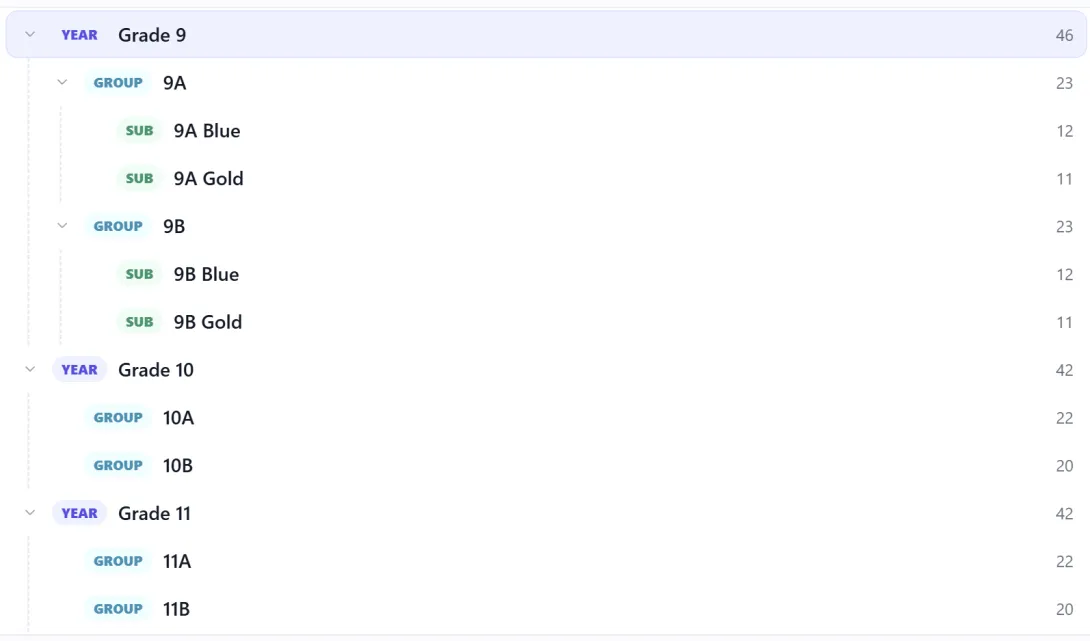
Someone on the FET forum once asked, more or less: what is a "group", exactly?
It is a fair question and it deserves better than the answer it usually gets, which is a definition that uses the other two words you also do not know yet.
So here is a school instead.
Year 9 does three different things
Year 9 goes to assembly. All hundred and twenty of them, in the hall, once a week. Nobody is split. That is a year.
Year 9 does maths in four classes. 9A, 9B, 9C, 9D — each with its own teacher, own room, same time or different times. Each of those is a group.
9A splits for languages. Half do Spanish, half do German, at the same time in different rooms. Each half is a subgroup.
Same students all week. Three different ways of dividing them, because three different lessons need three different divisions.
That is all the vocabulary is: the level at which a lesson divides the cohort.
Why it matters more than a naming convention
Here is the part worth internalising: the level you assign a lesson at is the level the scheduler protects against clashes.
Put assembly on the year and nothing else can be scheduled for anyone in Year 9 at that hour. Correct — they are all in the hall.
Put it on 9A instead and you have told the timetable that only 9A is busy. 9B is now free to do maths during assembly, and nothing is wrong as far as the software is concerned, because you said so.
The vocabulary is not bookkeeping. It is how you express who cannot be in two places at once.
One group can have two parents
This one surprises people, and it is deliberate.
A group does not have to belong to exactly one parent. The same set of students can sit under two — which is exactly how you describe a combined class, an option block drawn from two year groups, or a mixed set that exists for one subject only.
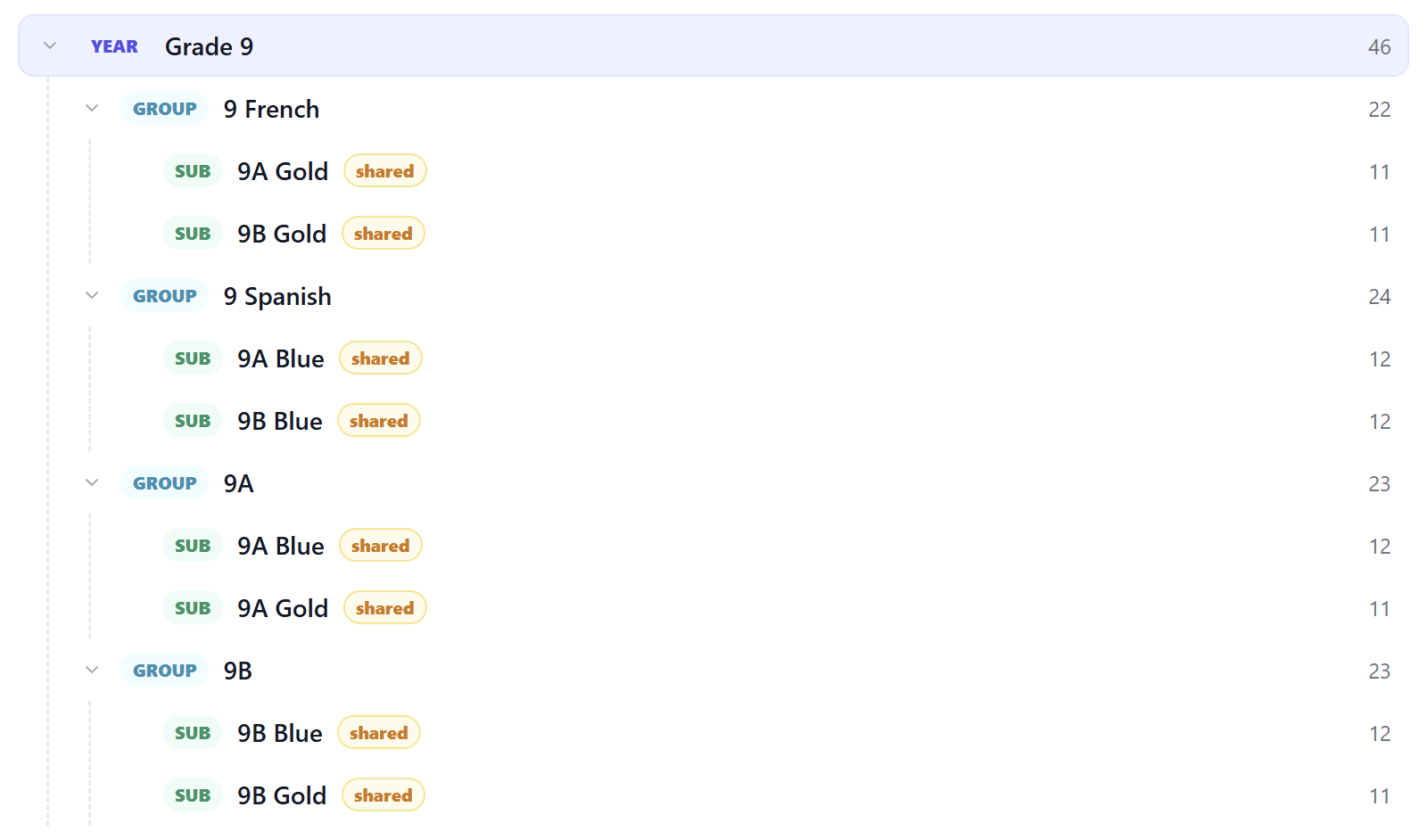
If you have ever had a sixth-form option taught to Year 12 and Year 13 together and wondered which year to file it under, the answer is: both. That is not a workaround.
The mistake that is hard to undo
If you are importing, there is one ordering rule worth getting right the first time.
Import your students before your activities.
An activity naming a student set that does not exist yet will have it created — but created flat, with no year above it and no subgroups below. And it is never upgraded afterwards. You end up with a pile of groups that look correct in a list and behave wrongly everywhere structure matters, and fixing it means deleting them and starting again.
The same auto-creation applies to teachers, subjects and tags named by an activity row. For those it is harmless — a teacher is a teacher. Which is precisely why the student case catches people out: five of the six imports forgive you, and the sixth does not.
Import students first and the hierarchy arrives correctly.
Two ways to look at it
The section shows the same data two ways: a columns view for working through one level at a time, and a tree view for seeing the shape as a whole. Your choice is remembered.
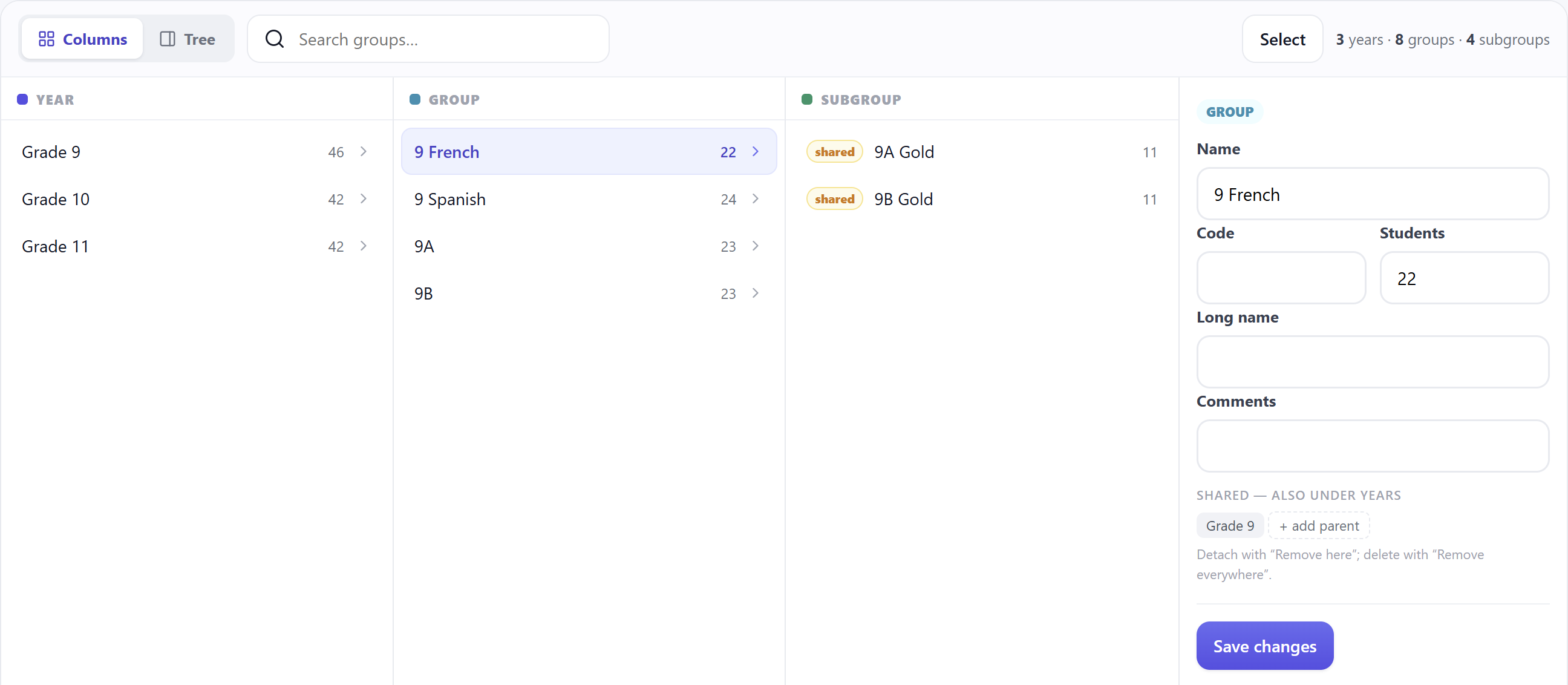
Use the tree when you are checking the structure is right. Use columns when you are entering it.
It was never complicated, only unexplained
Year, group, subgroup is one idea — how finely does this lesson divide the cohort? — wearing three words.
Once that lands, the rest follows: assign at the level that is genuinely busy, let a group have two parents when the students really do belong to both, and import your students first.