
"Which room is free on Tuesday at 11?"
The question you get asked in a corridor, and why your timetable is organised the wrong way round to answer it.
You are walking to lunch and someone stops you.
"Is anything in Lab 2 on Tuesday at eleven? We've got a visiting speaker."
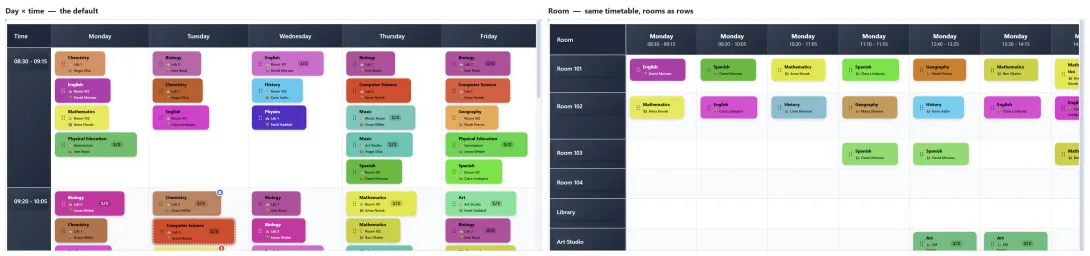
You know this. It is in the timetable you built. And you cannot answer, because the timetable is organised by class — thirty grids, one per group, and Lab 2 appears somewhere inside every one of them.
So it becomes "let me check and get back to you", and then it is a search through printouts, or a scan down thirty columns counting rooms.
The information is there. It is just filed under the wrong heading.
Timetables are built one way and read another
This is not a flaw in how you built it. A timetable is authored per class, because that is how the constraints are expressed — this group takes this subject this many times a week.
But it is consulted by resource. Which room is free. Which teacher is unassigned third period. Who else is teaching when I am.
Every timetabler ends up maintaining the second view in their head, and being the only person in the building who can answer.
Turn the grid on its side
Instead of one grid per class, you can ask for one row per room, with the days and hours along the top. The same timetable, pivoted — nothing recalculated, nothing re-solved, just filed under a different heading.
Lab 2 becomes a row. Tuesday at eleven becomes a column. The answer is where they cross, and it takes about a second.
The same works for teachers: one row each, their whole week in a line. "Who is free now?" stops being a question you research.
It gets better when you are actually placing something
Reading is the easy half. The useful part is when you are holding a lesson and looking for somewhere to put it.
Pick up a lesson that needs a room and switch to the room view: the grid marks which rooms are genuinely free at that day and hour — not free-looking, free — and which one the lesson is currently in. You are not comparing two grids and hoping. The question "where can this go?" is answered on the screen you are already looking at.
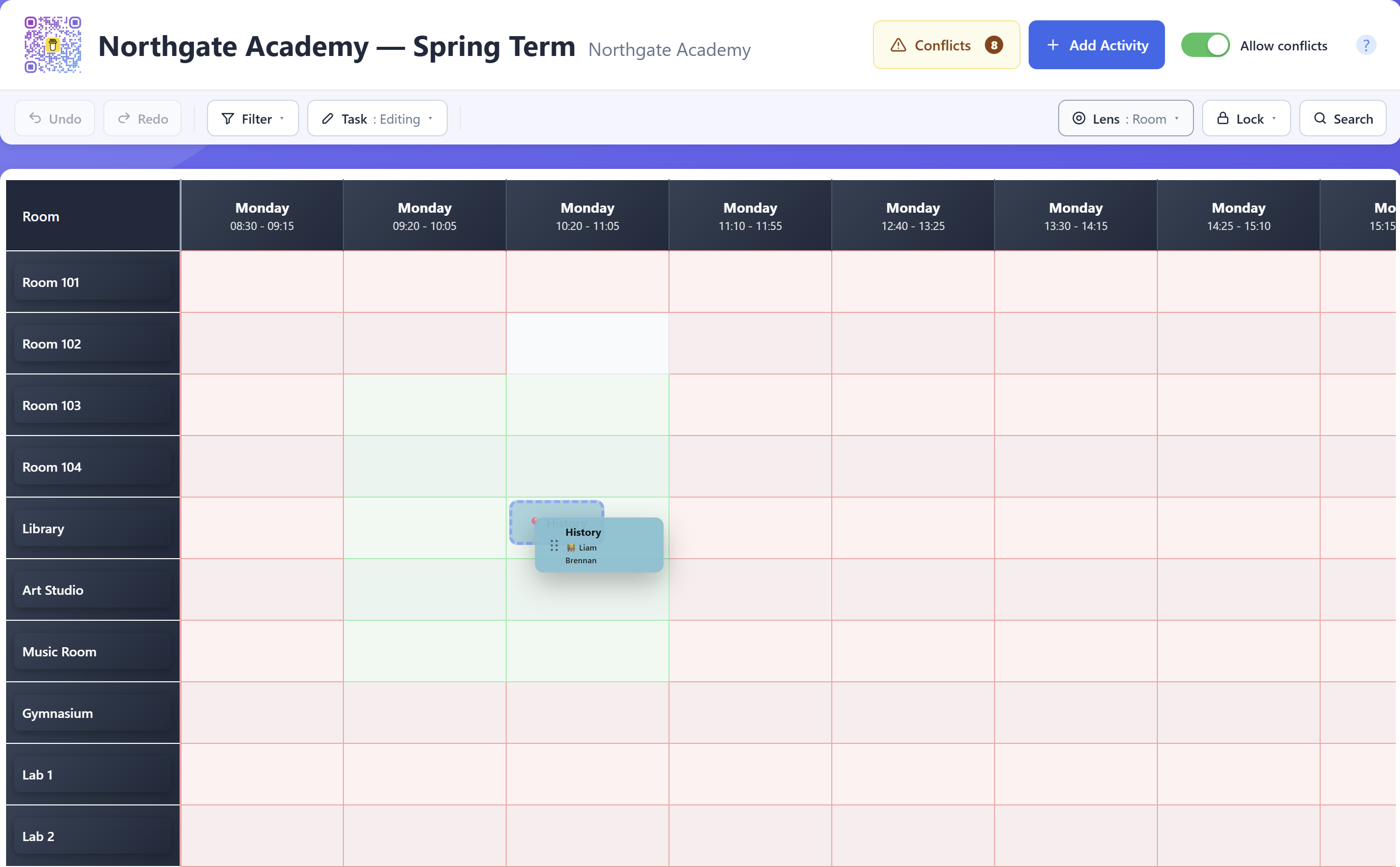
Then drag it into the row you want. The lesson changes room. You did not open a form, find the room field, or type a room name that has to match exactly.
And it tells you when you are wrong
Moving lessons by hand is where good timetables quietly break. You solve the speaker problem and create a clash two rows down that nobody notices until Tuesday.
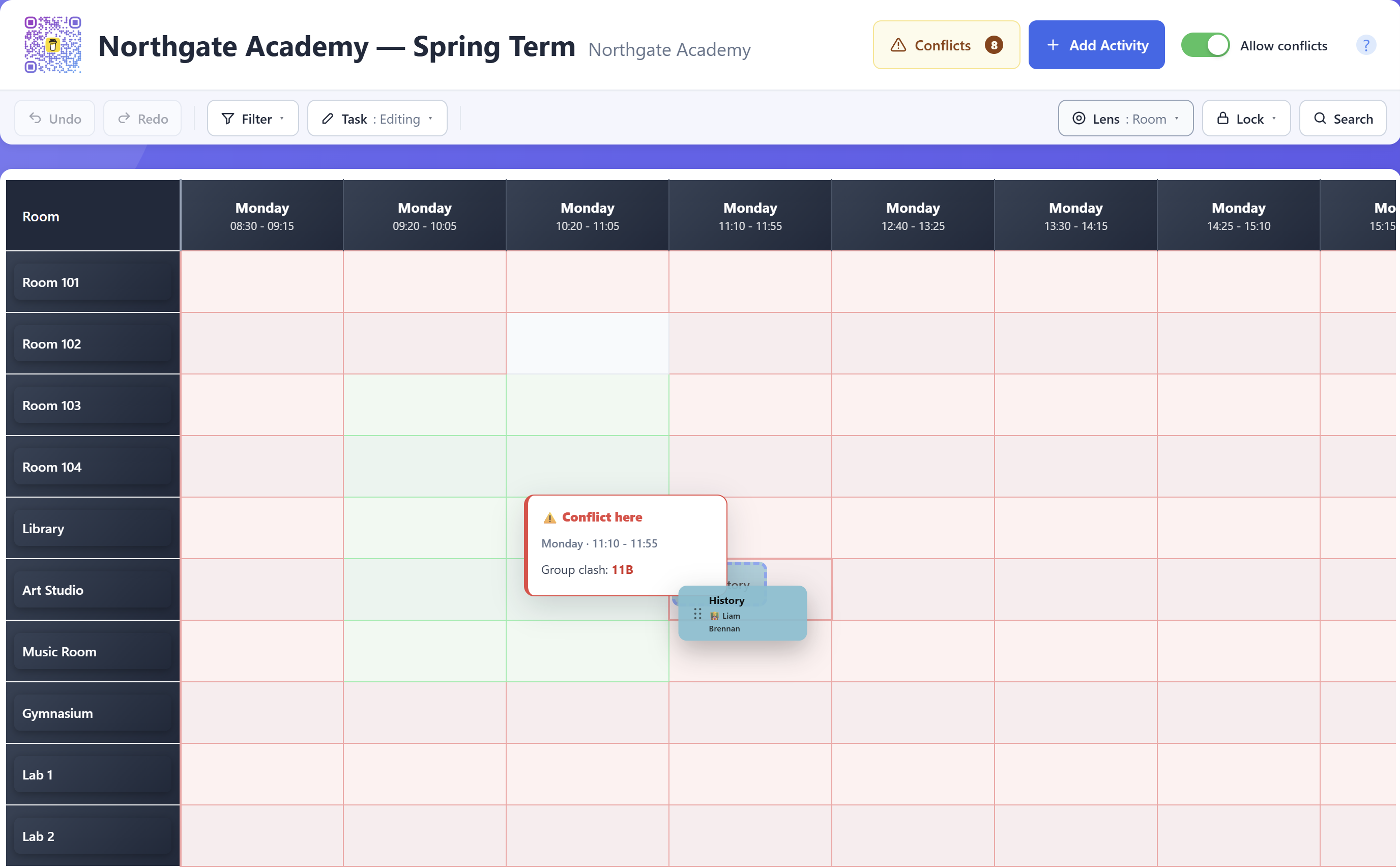
So the grid checks as you go. Move something into a slot that does not work and it says so immediately — not on save, not on next open. And anything that must not move can be locked, so the answer is "no" before the mistake rather than after it.
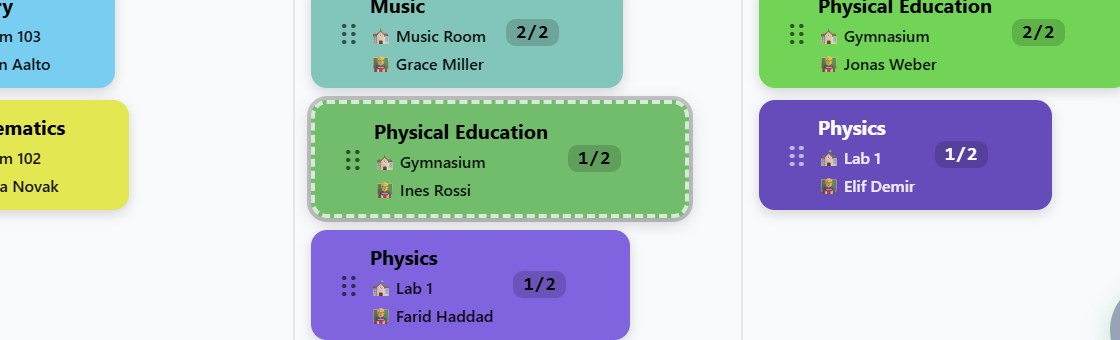
The corridor question, answered in the corridor
None of this is new information. Every one of these answers was already in your .fet file the moment the solver finished. It was just arranged for the computer that generated it, rather than for the person who has to live with it.
Turning the grid on its side does not change a single lesson. It changes who can answer a question about it — which, when you are the only person in the school who can read the timetable, is most of the job.
"Is anything in Lab 2 on Tuesday at eleven?"
Yes. Or no. In about a second, standing in the corridor.